2026 Skill Gaps: What Employers Need Most and Why
- February 20, 2026
- Posted by: Stage 4 Solutions
- Category: Blog
Workforce transformation continues to accelerate. Artificial intelligence, automation, and data-driven decision making are changing how organizations operate, while cybersecurity and compliance requirements continue to expand. For many employers, the challenge is no longer about accessing technology; rather, it’s about finding and developing the talent required to use it effectively.
According to the World Economic Forum’s Future of Jobs Report, 63% of employers say that skill gaps are now the biggest barrier to business transformation. The ability to anticipate emerging skills, attract qualified professionals, and upskill existing teams has become central to every organization’s growth strategy.
To understand which skill gaps organizations anticipate will most affect their hiring plans in the next year, we polled our community for their insights.
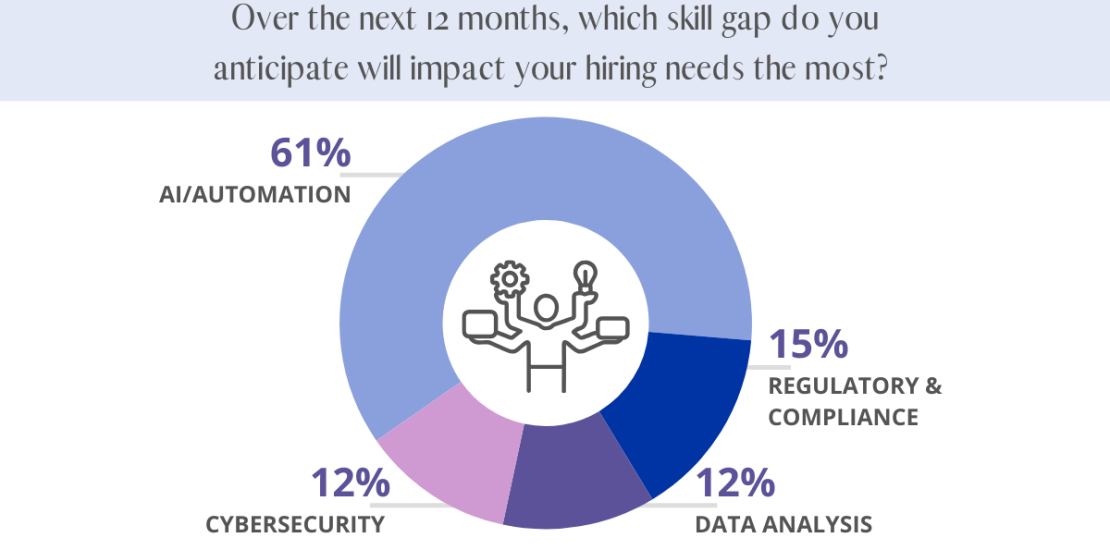
Over the next 12 months, which skill gap do you anticipate will impact your hiring needs the most?
- AI/automation 61%
- Regulatory & compliance 15%
- Cybersecurity 12%
- Data analysis 12%
AI and Automation
The majority (61%) of respondents identified AI and automation as the top skill gap that will impact their hiring needs, which comes as no surprise in a world where AI is embedded across a growing number of business functions. AI-driven automation has advanced into process intelligence, decision automation, and workflow orchestration at scale, creating new opportunities for professionals who can evaluate automation potential, balance efficiency with accuracy, and coordinate between business and technology teams.
According to LinkedIn’s Work Change Report: AI Is Coming to Work, AI-related positions are among the fastest-growing in the United States, led by roles such as AI Engineer, Machine Learning Specialist, Prompt Engineer, Automation Program Manager, and AI Operations Lead. Titles such as Automation Architect and Intelligent Process Engineer are also increasingly becoming essential to digital transformation programs.
Organizations want professionals who can integrate AI into existing operations, monitor outcomes, and ensure compliance with data, security, and governance requirements. These positions require a blend of technical depth, analytical insight, and operational understanding. AI specialists are expected to translate data into actionable results, aligning technology investments with measurable productivity, cost efficiency, and informed decision-making. As adoption expands, having professionals with AI expertise who can deliver operational value and ensure successful, responsible implementation is becoming even more central to remaining competitive.
Regulatory and Compliance
According to 15% of respondents, regulatory and compliance is the top anticipated skill gap. As technology advances, regulatory and compliance requirements have become increasingly complex. New mandates around data privacy, AI oversight, and Environmental, Social, and Governance (ESG) reporting have elevated compliance to a leadership priority. Employers are expanding hiring in roles such as Compliance Risk Manager, Data Privacy Officer, Governance Analyst, and ESG Reporting Specialist.
These roles have evolved from reactive monitoring to proactive risk management, intersecting with IT, data, and legal functions. Compliance professionals are now expected to design systems and processes that align with business objectives while ensuring transparency and accountability. The ability to translate regulation into operational practice is increasingly becoming one of the most valuable skill sets.
Cybersecurity
12% identified cybersecurity as the top skill gap that will impact their hiring needs in the coming year. Just a few years ago, cybersecurity consistently ranked as the number one skills gap. Reports from 2021 and 2022, including ISC²’s Cybersecurity Workforce Study, showed that nearly 63% of organizations had unfilled cybersecurity positions, and the global shortage exceeded 3 million professionals.
That urgency has not diminished, but the context has evolved. Security is now built into every layer of technology and operations rather than managed as a standalone discipline. The focus has shifted from purely defensive functions to integrated risk management across data, cloud, and AI environments. Current hiring trends emphasize roles such as Cloud Security Engineer, Security Architect, Cyber Threat Analyst, and AI Security Specialist, positions that combine technical expertise with systems thinking.
Today’s professionals must address emerging challenges such as data leakage prevention, AI model protection, and identity governance while collaborating with compliance and technology teams. Rather than viewing cybersecurity as a barrier, organizations now treat it as a core enabler of continuity and innovation.
Data Analysis
12% marked data analysis as their top skill gap. Data remains the backbone of sound decision-making. Every AI system, predictive model, and performance dashboard relies on clean, interpretable data and professionals who can turn it into insight. Companies continue to compete for Data Analysts, Business Intelligence Managers, Data Scientists, and Data Governance Leads.
What has changed is the proximity of these roles to business outcomes. Many organizations are embedding analysts within product, operations, and customer teams to enable faster, data-informed decisions. The modern analyst is expected not just to report findings but to recommend actions, measure impact, and communicate insights clearly to leadership. This evolution has turned data analysis from a support function into a key driver of strategic execution.
Bridging the Skill Gaps
As technology advances, the demand for specialized skills continues to outpace supply. These gaps now affect every aspect of organizational performance, from innovation and productivity to compliance and security. At Stage 4 Solutions, we help organizations address these challenges by providing skilled professionals for both short-term and long-term needs to support critical initiatives and deliver results.
Which skill gaps do you anticipate will impact your hiring needs the most in the near future? We’d love to hear from you.
