AI Layoffs Today, Rehiring Tomorrow?
- October 27, 2026
- Posted by: Stage 4 Solutions
- Category: Blog
As organizations increasingly adopt AI to improve productivity and reduce costs, some are eliminating positions based on the work they expect AI to perform. However, these decisions don’t always deliver the anticipated savings. Gartner predicts that by 2029, 30% of employees laid off due to AI-driven job replacement will need to be rehired, often at a significantly higher cost. To better understand what organizations are currently experiencing, we polled our community for their insights.
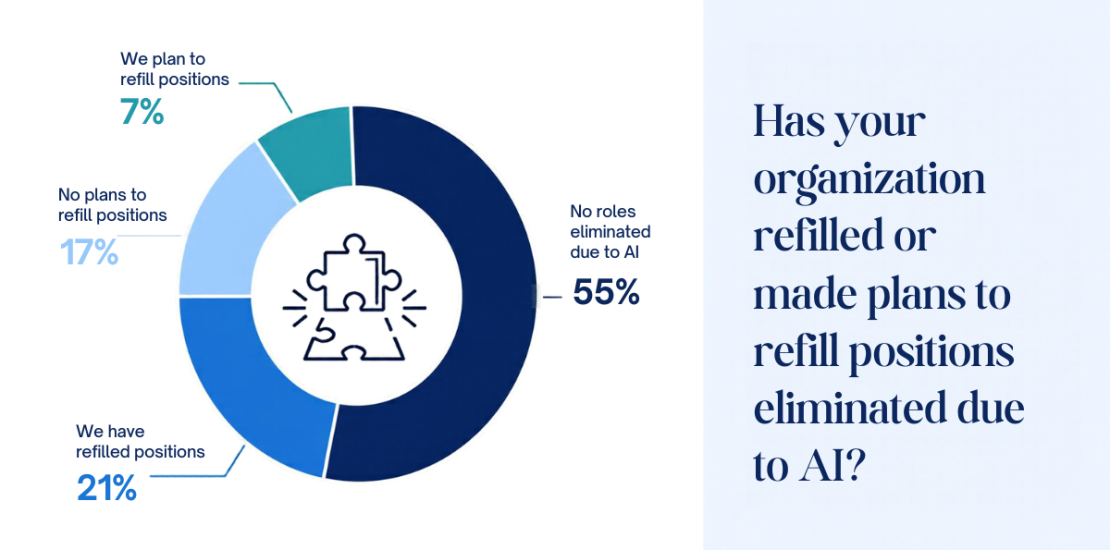
Has your organization refilled or made plans to refill positions eliminated due to AI?
- We have refilled positions: 21%
- We plan to refill positions: 7%
- No plans to refill positions: 17%
- No roles eliminated due to AI: 55%
The majority of our poll respondents (55%) reported that their organizations have not eliminated positions due to AI. This result was surprising given the news reports that are dominated by AI-driven layoffs at many technology and other leading companies. We believe that our poll is more accurate than the headlines because we see many companies hiring, and we here at Stage 4 Solutions are expanding our internal team to manage client growth. We also believe that many layoff announcements mention “AI” as an “acceptable” excuse for layoffs that perhaps are driven by other business decisions.
Among respondents whose organizations have made AI-related cuts, nearly two-thirds reported that their organizations have already refilled positions or plan to do so.
These findings raise an important question: Why are organizations rehiring for positions they eliminated because of AI?
One reason is that while AI can automate individual tasks, it cannot necessarily replace all the responsibilities associated with a position. Employees still handle complex situations and make business decisions that require human judgment beyond AI’s capabilities. Eliminating positions based solely on tasks that can be automated may leave critical responsibilities unaddressed. Another reason is inadequate change management during AI implementation. Companies may not fully account for the time and resources needed to redesign workflows, train employees, and adapt existing processes while maintaining day-to-day operations. Additionally, AI-generated work still needs to meet the organization’s quality standards, requiring employees to review outputs and correct errors as needed. The time and resources required for these activities may reduce the anticipated efficiency gains.
When organizations reduce staff before fully understanding these requirements, they risk losing institutional knowledge, disrupting operations, and incurring additional recruitment and training costs if they need to rehire. To reduce these risks and realize the full benefits of AI, business leaders should consider the following:
Evaluate AI performance before eliminating positions. Assess the entire role rather than focusing on individual tasks that AI can automate. Account for the time employees must spend reviewing and correcting AI-generated work. Measure actual improvements in productivity and quality before making permanent staffing decisions.
Redesign roles and invest in existing employees. As AI automates certain tasks, evaluate how employees’ roles can evolve rather than assuming those positions are no longer needed. Identify opportunities for experienced employees to take on higher-value responsibilities that require business knowledge and judgment. Invest in training and effective change management to help employees adapt to new workflows while retaining the institutional knowledge needed to maintain business operations.
Evaluate the overall return on AI investments. Look beyond immediate payroll savings when evaluating the financial return on AI investments. Include implementation expenses, ongoing oversight costs, and the potential cost of rehiring if positions are eliminated prematurely. Consider these costs when determining whether AI investments are delivering the expected financial benefits.
Maintain flexibility in workforce planning. As organizations implement AI and assess its impact on existing roles, staffing requirements may change. Experienced contract professionals can help maintain operations and cover critical responsibilities while companies evaluate their long-term needs. Contract-to-perm arrangements also provide an opportunity to assess revised roles before committing to permanent hires.
Planning for the Workforce Impact of AI
Successful AI adoption requires more than implementing new technology. Companies must also manage the transition effectively and adapt their operations and workforce to new ways of working. Taking these factors into account can help organizations realize the benefits of AI while avoiding premature staffing reductions and the costs of rehiring.
At Stage 4 Solutions, we help organizations fill critical resource gaps with experienced contract and contract-to-perm professionals across marketing, IT, engineering, and business operations. Whether companies need additional resources during AI implementation or must refill positions as staffing requirements change, we help them access the expertise they need without immediately committing to permanent hires.
How is your organization approaching staffing decisions as AI adoption expands? Please share your experience with us.
